
Using Ayurveda to Guide Your Life
- Georgia Morelli
- Mar 23, 2020
- 6 min read
Updated: Mar 30, 2020
A theme of this blog is following your intuition and listening to your body when it comes to eating, exercising, sleeping, living. Remember the golden word: bioindividuality. True, none of us are exactly alike in terms of our physical and mental needs – but what if I told you about an ancient medical system, that can tell each of us how to look after our body type?
Ayurveda means the “science of life” in Sanskrit. It has been taught for thousands of years in India, so is one of the oldest healing sciences in the world – it way out-does Western medicine on the scientific timeline. As more of us become frustrated with the limitations of mainstream doctors and prescribed pills, and more interested in holistic health solutions to answer our complex problems, Ayurveda is gaining popularity.
I love it for three main reasons:
It encourages you to create balance in your lifestyle, diet and mindset
It enables you to make lifestyle changes based on your own individual constitution
It emphasises prevention and maintenance of health, not just cures
This third point is particularly important as we continue to se the rise of lifestyle diseases, most of which are completely preventable through healthy choices. Yes, Ayurveda is fantastic for those suffering with ill health, as it will help you bring balance back to your body. But it is also a life-long system to follow, so that you will always have a healthy mind, body and soul.
So whether you are experiencing symptoms right now that you want to address, or you just want to implement healthy lifestyle practices to set you up for life, this is some wisdom you do not want to miss.

Firstly, how does Ayurveda work?
Let me introduce some of the underlying concepts of Ayurveda.
There are five great elements: space, air, fire, water and earth.
Then, there are three types of energy that work together within our bodies.
Vata – the energy of movement, moving fluids and nutrients around the body to allow us to function
Pitta – the energy of digestion
Kapha – the energy of joint lubrication, muscle and bone structure, and immunity

We all have the energies of vata, pitta and kapha inside us. But what makes us unique is that we have a different balance of the three: one energy is usually primary, and the other two are less prominent.
This is called your dosha – the tendency of an energy to be dominant in you. Your dosha classification does not change during your life; but, if your energies become too out of balance, disease will present itself.
So how do I find my dosha?
Figuring out whether you are primarily a vata, pitta or kapha constitution is all based on physical and mental characteristics. For thousands of years, Ayurvedic practitioners were able to discern someone’s dosha by looking at a patient’s body shape and colouring, and asking questions about their eating, sleeping and exercising habits.

As you can see, the general ‘body type’ of each dosha is very similar to the Western designation of endomorph, mesomorph and ectomorph. But Ayurveda goes further than just physical shape.
If you’re interested in getting a completely accurate understanding of your constitution, practitioners are beginning to pop up even in the Western world, where you can get an in-depth consultation. Try Googling for Ayurvedic practices in your area.
Otherwise, it’s as easy as taking an online quiz – which are just as fun as Buzzfeed ones.
A great one is by Banyan Botanicals, an Ayurvedic lifestyle and herb company. Check it out at https://www.banyanbotanicals.com/info/dosha-quiz/. The questions on this quiz are fantastic for determining your primary and secondary doshas.
Here’s an example of what mine looks like.

As you can see, my primary dosha is pitta. This means my symptoms of ill health will usually come from an elevated pitta – so throughout my life, I will have to actively keep my pitta in balance.
The quiz will also analyse the other imbalances your body is experiencing based on your current symptoms.
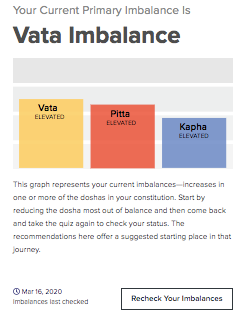
Currently, I also have an elevated vata that is upsetting my body’s balance, which I must also address. So although pitta people will be more prone to experiencing symptoms of an elevated pitta, your primary dosha might not always be the sole imbalance.
You can check back in the future by taking the quiz again and seeing what imbalances may appear. But remember, your constitution will not change: that is your natural state.

Now what do I do?
After finding your constitution, start making lifestyle changes that are going to actively keep your doshas in balance. You can think of it as preventative: introducing lifelong habits to support your individual needs. You can also think of it as healing: working on your elevated doshas to restore balance and remove disease.
Let’s go into detail about each dosha.

If you’re a vata, you’re blessed with creativity, great bursts of energy, and initiative to start many new exciting things. Your naturally light body means you can remain lean throughout life, yet you often experience sudden bouts of fatigue, disrupted sleep and trouble digesting some foods.
But excessive stress makes a vata unbalanced: anxiousness, restlessness, insomnia, weight loss, constipation and irregular digestion. If you start to notice these symptoms, focus on bringing warmth, stability and consistency to your life.

To rebalance an elevated vata, we need to think about warming and grounding:
Always remain warm by dressing adequately and using blankets
Touch loved ones and pets, have regular massage rituals
Bring more heat by drinking tea, eating cooked and spicy foods
Eat your meals at regular times and don’t skip eating for the sake of your projects!
Focus on hydration through water intake, soups, and baths
Choose light exercise for balance and flexibility like yoga, walking, and dance – nothing that pushes yourself too far
Use deep breathing and meditation to focus on slowing down and resting an active mind
Make time to enjoy positive creative pursuits like music, art, writing, dance

Pittas are our leaders, sharp thinkers, decision-makers and teachers. You have fantastic concentration, drive and a sharp wit. Your athletic body, powerful digestion, ravenous appetite and good sleeping habits give you strength and energy. But when overstressed, pittas become short-tempered and argumentative, experiencing indigestion, excessive body heat, skin rashes and acne.

For pitta, we focus on cooling, sweetening and creating space:
Take breaks regularly to bring spaciousness into your day, balance activity and rest
Do not skip meals or wait until you’re starving to eat
Eat cooling foods and sweet fruits, but limit spice and salt
Use water to cool yourself, especially swimming
Make time to enjoy wide, open spaces and fresh air, like gazing at the night sky, walking in open natural environments, use a fan
Exercise during the cooler parts of the day
Make time to laugh and play to bring lightness

A kapha is that special person who is naturally loving, calm, steady and reliable. They don’t mind routine and just generally enjoy life. Distinguished by their strong build, kapha have amazing stamina and sleep like babies, but not as strong digestive fire as pittas.
In the face of stress, a kapha will become resistant to change and stubborn, holding onto relationships or things that no longer serve them. Excess kapha also manifests as weight gain, allergies, congestion, sluggishness and depression.

For balancing kapha, we want to be invigorating and cleansing:
Stick to a regular daily routine and avoid long sleep-ins or daytime napping
Cultivate fire through aerobic exercise, focusing on building endurance through running, swimming or competitive sports
Seek stimulation of new experiences and challenges to balance kapha’s heaviness and tendency to cling to habits
Activate the mind with mental challenges like games and puzzles
Clear out spaces of clutter to avoid things accumulating
Eat your largest meal at lunchtime, with a smaller dinner at least 3 hours before bed
Eat light and fresh foods, but avoid dairy, fatty, oily and sugary foods to limit congestion
Spicy foods and coffee can also invigorate a sluggish kapha metabolism
Stay warm and dry, using a heating pad under your back if congested and keeping your nose and throat covered from the cold
These are some basics that you can start to implement once you find your unique constitution.

Remember, Ayurvedic medicine is not a substitute for Western practices. Sometimes diseases, especially acute ones like bacterial infections or life-threatening illnesses, must be treated with surgery or drugs.
But what Ayurveda can do for your lifelong health and wellbeing is much more beneficial than conventional medicine. By supporting your dosha, your body will experience minimal stress and a flow of energy. This strengthens your immune system so that you may never need emergency treatments from a doctor. And if you’re feeling unbalanced and unwell, use these techniques to bring yourself back into balance.
This is your first step on the path to wellness: getting to know yourself and appreciating your unique needs. The more we understand about ourselves – our amazing qualities when we’re balanced, and the common tendencies we fall into when unbalanced – the easier it will be to maintain good health.
When we follow these practices throughout our lifetime, we are serving and caring for our bodies. To know yourself is to love yourself.


Comments